Why is the palace of Tianning Temple in Yangzhou called "Jiangnan Small Forbidden City"? | Canal 100 Questions 60

[Editor’s note]
Long canal, blue waves still; The context of a thousand years goes on and on. In order to let the netizens better understand the history of the Canal and feel the culture of the Canal, our website, official website, the Grand Canal Cultural Tourism Expo, launched the column "Hundred Questions on the Canal", inviting experts to comprehensively and systematically introduce the historical and cultural resources with the Grand Canal as the core, carefully combing the cultural symbols along the Canal from the perspectives of cultural inheritance, cultural identity and cultural going out, and leading netizens through the 2500-year history of the Grand Canal with interesting knowledge points, and stepping into a colorful and swaying online canal cultural corridor.
Question 60: Why is the palace of Tianning Temple in Yangzhou called "Small Forbidden City in Jiangnan"?
Yangzhou Tianning Temple Palace is located at No.3 Fengle Shangjie, Yangzhou.It was the imperial palace in Yangzhou during the southern tour of the Qing Dynasty.It covers an area of about 11,602 square meters with a total construction area of more than 5,000 square meters.
According to legend, Tianning Temple was originally Xie ‘an Villa, a Taifu in the Eastern Jin Dynasty. In the tenth year of Taiyuan (385), Xie ‘an Town lived here in Guangling, and the house behind it was a temple named "Xie Sikong Temple". Emperor Kangxi of the Qing Dynasty stayed here during his southern tour. During Qianlong’s second southern tour, the Palace, the Imperial Garden and the Wenhui Pavilion were built here. Xianfeng years was destroyed by fire, Tongzhi reconstruction. Up to now, the imperial tablet of Qianlong’s southern tour, which is engraved with the southern tour, still stands on the north side of the mountain gate hall in the temple. "The southern tour is more important than a river worker." The southern tour written by Qianlong himself points out the main purpose of the emperor’s southern tour.The Southern Tour Imperial Monument has also become a unique material evidence fixed in a specific historical period.
Tianning Temple complex is composed of Shanmen Hall, Tianwang Hall, Ursa Major Hall, Huayan Pavilion, East and West Corridor Rooms and Accessory Halls.The main buildings are located on the north-south central axis, and the secondary buildings are arranged on the east and west sides of the axis, forming a pattern of "one temple, five doors in the world, two corridors and ten halls in the world". The whole building complex is symmetrically distributed, with strict layout and orderly, which is a traditional quadrangle-style temple building complex in China. There is a subtle and natural connection between the elements in the complex, which reflects the "implicit" relationship between the ancient buildings in China and the same buildings. From a distance, it seems to be floating in the white clouds, and it is praised by many people as the "Small Forbidden City in the South of the Yangtze River". Emperor Qianlong organized the compilation of Sikuquanshu, the largest series in China, and wrote seven books, which were collected in Wenyuan Pavilion in the Forbidden City, Wenyuan Pavilion in Yuanmingyuan, Wenjin Pavilion in Rehe Palace, Wenshui Pavilion in Fengtian Palace, Wenhui Pavilion in Tianning Temple in Yangzhou, Wenzong Pavilion in Jinshan Temple in Zhenjiang, etc. The Wenhui Pavilion of Tianning Temple in Yangzhou is a part of the emperor’s palace, and it contains one of the seven books of Sikuquanshu and the whole book "Integration of Ancient and Modern Books". Unfortunately, during the Taiping Heavenly Kingdom war, the Chinese Huige was destroyed, and there were no books left.
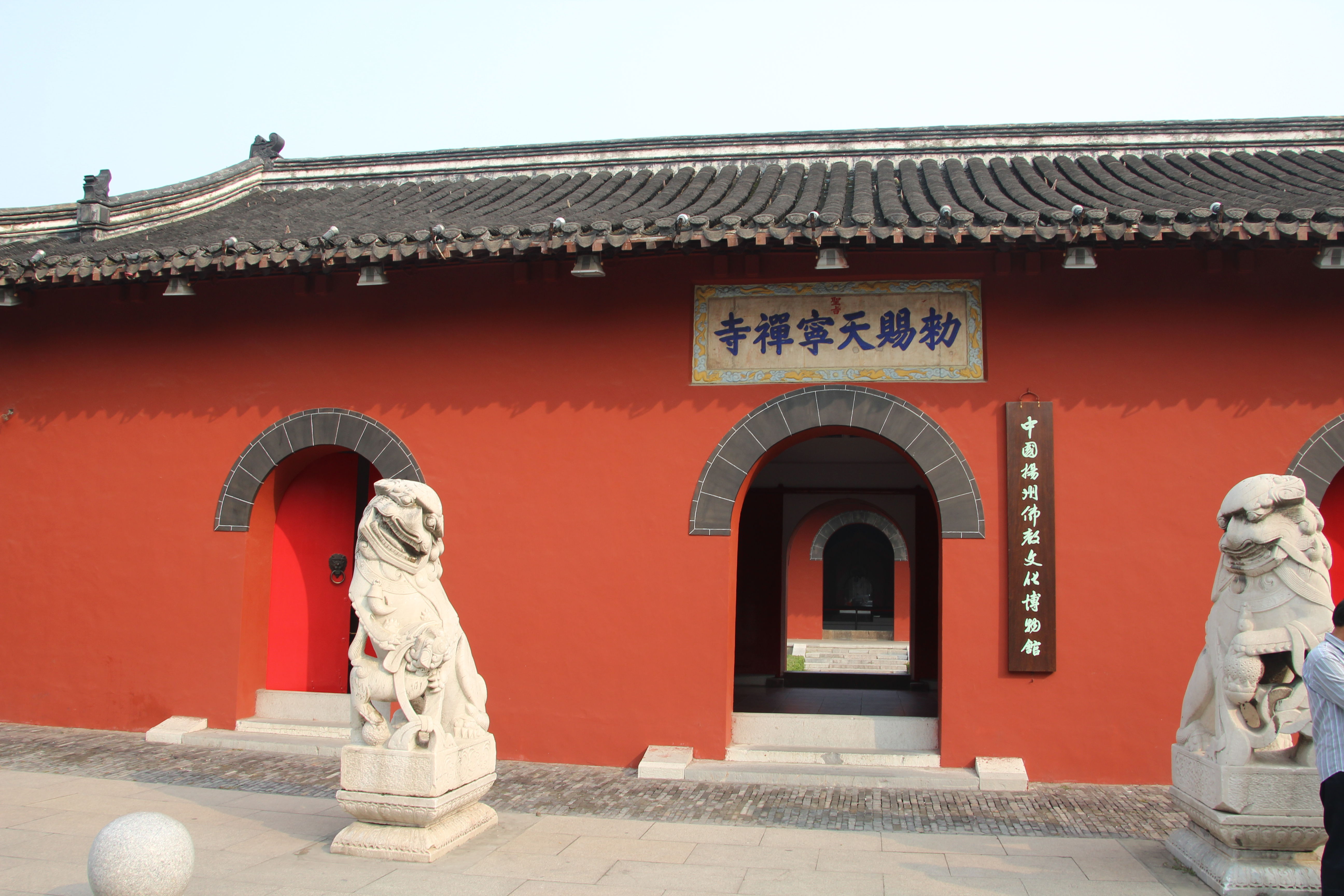
Yangzhou Tianning Temple
Near Tianning Temple, there is another temple called Zhongning Temple.Zhongning Temple was built in the prosperous time of Qianlong. Legend has it that it was built for Qianlong’s mother’s birthday.. Before Ganlong’s last southern tour, Yi Ling ‘a, a salt official of two Huai Dynasties, played on the court, saying that Yangzhou salt merchants urgently requested to build Zhongning Temple behind Tianning Temple, and this memorial was approved by Ganlong. About a year later, a new temple funded by salt merchants and presided over by monks was completed. Qianlong personally gave the temple a name, called "Wanshou Zhongning Temple". "The longevity of Wan’s surname is longevity, so it is longevity; The following people’s ning is ning, so it is important to ning. " Chongning Temple covers an area of 11,800 square meters, with a building area of about 2,000 square meters. It faces Tianning Temple across the road and is called "Shuangning". There are three existing buildings, namely, the Heavenly King Hall, the Ursa Major Hall and the Tibetan Scripture Building. The first entrance to the central axis of the mountain gate is the Temple of the King of Heaven, in which the tablets of "Universal Solemnity" and "Wonderful Rain Flower Fragrance" given by the emperor Qianlong in the forty-eighth year (1783) are original objects, and the Monument of Wanshou Chongning Temple written by Emperor Gaozong Hongli of Qing Dynasty is saved.

Zhongning temple
Author Jiang Shili:
Deputy Director of Yangzhou Press and Publication Bureau.During the application for the World Heritage of the Grand Canal in China, he served as the full-time director of the World Cultural Heritage Office of the Grand Canal and the deputy director of the World Heritage Office of Yangzhou, the leading city, and experienced the process of applying for the World Heritage of the Grand Canal.
(Jiangsu Radio and Television General Station "My Su Net Special",It is only for the publicity of the Expo, and it is not allowed to be reproduced., reserve the right to pursue legal responsibility. )