Chinese scientists have achieved new breakthroughs in key core technologies in many frontier scientific and technological fields.
For the first time in China, triatomic molecules were synthesized in ultra-cold atomic-molecular mixture.
Pan Jianwei and Zhao Bo of China University of Science and Technology cooperated with Bai Chunli Group of Institute of Chemistry, Chinese Academy of Sciences to synthesize triatomic molecules in ultracold atomic-molecular mixture for the first time, which is an important step towards the research of quantum simulation based on ultracold atomic molecules and ultracold quantum chemistry. The result was published in Nature on February 10th.
Quantum computing and quantum simulation have powerful parallel computing and simulation capabilities, which can not only solve computational problems that classical computers cannot handle, but also effectively reveal the laws of complex physical systems, thus providing guidance for new energy development and new material design. Using highly controllable ultra-cold quantum gas to simulate complex and difficult-to-calculate physical systems can accurately study complex systems in all directions, so it has a wide application prospect in chemical reactions and new material design.
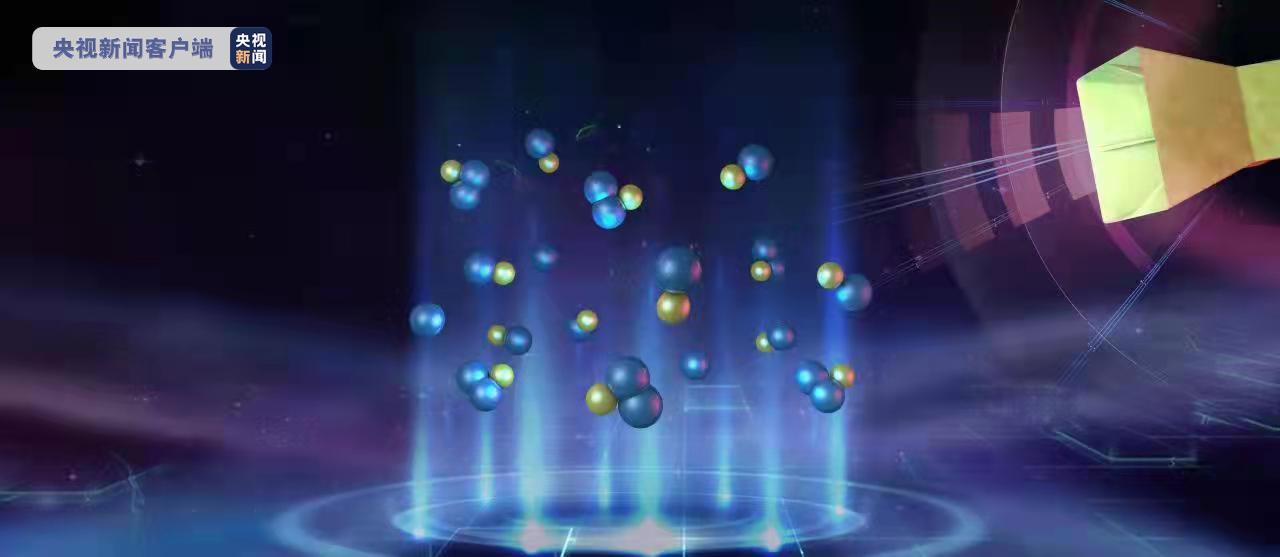
Schematic diagram of triatomic molecules formed from the mixture of ultracold atoms and diatomic molecules by radio frequency field
Ultra-cold molecules will open up new ideas for quantum computing and provide an ideal platform for quantum simulation. However, it is very difficult to prepare ultracold molecules by direct cooling because of the complex vibrational and rotational energy levels inside the molecules. The development of ultracold atomic technology provides a new way to prepare ultracold molecules. People can bypass the difficulty of directly cooling molecules and synthesize molecules from ultra-cold atomic gas by laser and electromagnetic field. The synthesis of triatomic molecules from the mixture of atoms and diatomic molecules is an important research direction in the field of synthetic molecules.
In 2019, the research team of China University of Science and Technology first observed Feshbach resonance of atoms and diatomic molecules at ultra-low temperature. Near Feshbach resonance, the energy of bound state and scattered state of triatomic molecule tends to be consistent, and the coupling between scattered state and bound state is greatly enhanced by resonance. The successful observation of Feshbach resonance of atomic molecules provides a new opportunity for the synthesis of triatomic molecules.
In this research, the research team of China University of Science and Technology cooperated with the research team of Institute of Chemistry of Chinese Academy of Sciences to successfully synthesize triatomic molecules by using RF field for the first time. In the experiment, they prepared sodium and potassium ground-state molecules in a single ultra-fine state from the ultra-cold atomic mixture near absolute zero. Near the Feshbach resonance of potassium atom and sodium-potassium molecule, the scattering state of atomic molecule and the bound state of triatomic molecule are coupled together by radio frequency field. They successfully observed the signal of triatomic molecules synthesized by radio frequency on the radio frequency loss spectrum of sodium and potassium molecules, and measured the binding energy of triatomic molecules near Feshbach resonance. This achievement opens up a new way for the study of quantum simulation and ultracold chemistry.
Chinese scientists set up a new method of protein’s ab initio design.
Based on the data-driven principle, the team of Professor Liu Haiyan and Associate Professor Chen Quan of China University of Science and Technology opened up a brand-new protein ab initio design route, realized the original innovation of key core technologies in the frontier science and technology field of protein design, and laid a solid foundation for the design of functional proteins such as industrial enzymes, biomaterials and biomedical proteins. Related results were published in Nature on February 10th, Beijing time.
Protein is the foundation of life and the main executor of life function. Its structure and function are determined by amino acid sequence. At present, protein, which can form a stable three-dimensional structure, is almost all natural protein, and its amino acid sequence is formed by long-term natural evolution. When the structure and function of natural protein can not meet the needs of industrial or medical applications, it is necessary to design its structure in order to get specific functional proteins. In recent years, RosettaDesign— — Natural structural fragments are used as building blocks to splice and produce artificial structures. However, this method has some shortcomings, such as single design result and being too sensitive to the details of the main chain structure, which significantly limits the diversity and variability of the main chain structure.

The relevant teams of China University of Science and Technology have been deeply involved in the basic research and applied basic research of computational structural biology for a long time. Academician Shi Yunyu is a pioneer in this field in China. Professor Liu Haiyan and Associate Professor Chen Quan have been committed to developing data-driven protein design methods for more than ten years. The team first established the ABACUS model of designing amino acid sequence for a given backbone structure, and then developed the SCUBA model which can design a new backbone structure from scratch when the amino acid sequence is undetermined. Theoretical calculation and experiments show that designing the main chain structure with SCUBA can break through the limitation that only natural fragments can be spliced to produce new main chain structures, thus significantly expanding the structural diversity of ab initio design proteins, and even designing novel structures different from known natural proteins. "SCUBA model +ABACUS model" constitutes a complete tool chain that can design artificial protein with brand-new structure and sequence from scratch. It is the only protein ab initio design method that has been fully verified by experiments outside RosettaDesign, and it complements each other. In this paper, the team reported the high-resolution crystal structures of nine protein molecules designed from scratch, among which five protein molecules have novel structures different from known natural proteins.
The reviewer thinks that the method proposed in this work is novel and practical enough. It is challenging to design protein from scratch. The high-resolution design of six different protein in this work is an important achievement, which proves that this method works well.
China scholars are atCage orderDiscovery of new electrons in superconductorsNematic phase
A team composed of Chen Xianhui, Wu Tao and Wang Zhenyu of China University of Science and Technology recently discovered a new electronic nematic phase in cage superconductor CsV3Sb5. This discovery not only provides important experimental evidence for understanding the abnormal competition between charge density wave and superconductivity in cage-structured superconductors, but also provides a new research direction for further studying the interleaving order closely related to unconventional superconductivity in associated electronic systems. Related results were published in Nature on February 10th.
Electronic nematic phase widely exists in high-temperature superconductors, quantum Hall insulators and other electronic systems, and is closely related to high-temperature superconductivity, so it is considered as an interleaving sequence associated with high-temperature superconductivity. It is an important research direction in the current field to explore the superconducting material system with new structure, so as to further study the relationship between superconductivity and various interweaving orders, and one of the most concerned systems is the two-dimensional cage structure. Theoretically, it is predicted that the two-dimensional cage system can present novel superconductivity and rich electronic ordered states, but there is a long-term lack of suitable material system to realize its related physics. The discovery of cage superconductor CsV3Sb5 provides a new research system for the exploration in this direction.
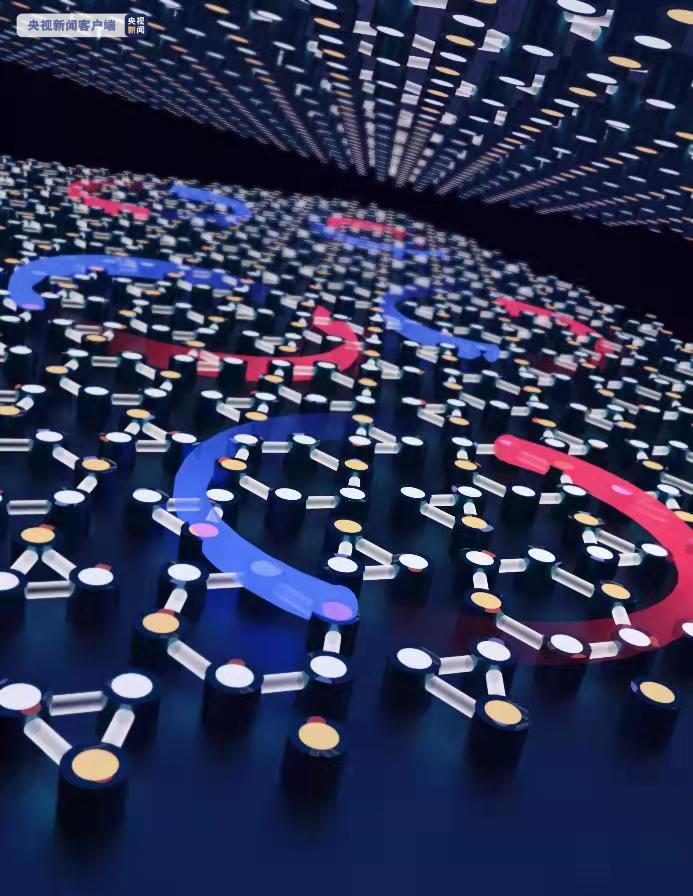
Physical schematic diagram of electron nematic order and superconductivity caused by triple modulated charge density wave in cage structure superconductor
Chen Xianhui’s team has successfully revealed the charge density wave state of in-plane triple modulation in this system, and the abnormal competitive relationship between charge density wave and superconductivity under pressure.
On this basis, the team combined scanning tunneling microscope, nuclear magnetic resonance and elastic resistance, and found that the triple modulation charge density wave state would further evolve into a thermodynamically stable nematic phase before the system entered superconducting state, and the transition temperature was determined to be around 35 Kelvin. The new electronic nematic phase has Z3 symmetry and is described by the three state Potts model in theory, so it is also called "Potts" nematic phase. Interestingly, this new electronic nematic phase has also been observed in the double-layer corner graphene system recently.
This achievement not only reveals a new type of electronic nematic phase in cage-structured superconductors, but also provides experimental evidence for understanding the competition between superconductivity and charge density waves in this kind of system. Previous scanning tunneling spectroscopy studies show that there may be paired density wave states (PDW) formed by the interweaving of superconductivity and charge density wave sequences in CsV3Sb5 system. The nematic order of electrons found above the superconducting transition temperature can be understood as an interleaving order related to PDW, which also provides important clues and ideas for understanding PDW in high temperature superconductors.
(Headquarters reporter Wang Li)