The super typhoon "Candu" is approaching China. Why is the autumn typhoon so fierce?
Cctv newsAccording to China Weather Network, in September, the 13th typhoon "Kang Sen" and 14th typhoon "Candu" came into being in succession, and gradually approached China, and Candu was transformed into a super typhoon with four consecutive jumps in a short time. In the eyes of many people, summer is the most active season for typhoons, and it is also the most disaster-prone season for typhoons. In fact, the power and influence of autumn typhoons cannot be underestimated. China Weather Network specially counted the meteorological data from 1949 to 2020, and found that there were more "malicious roles" in autumn typhoons.
Landing time: Typhoon is still active in September, and typhoon in autumn should not be underestimated.
Usually, we call typhoons generated from June to August "summer typhoons" and typhoons generated from September to November "autumn typhoons". Statistics show that in the past 72 years, the number of typhoons generated in summer is 833, which is the most active season for typhoons, and there are also 821 typhoons generated in autumn, second only to summer.
Judging from the situation of landing in China, the influence of autumn typhoon can not be underestimated. The data from 1949 to 2020 show that there are about 4.43 typhoons landing in China every summer, which is the season with the most typhoons landing in China. Every autumn, an average of 2.36 typhoons land in China, which is the second active season for typhoons; The average number of typhoons landing in spring and winter each year is less than 0.2.
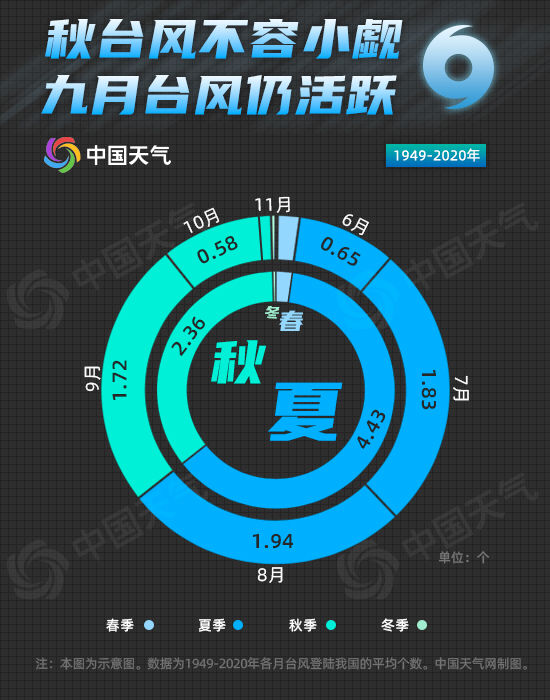
In autumn, September is the most active, with an average number of landings reaching 1.72, second only to August (1.94) and July (1.83), which are the most frequent typhoons, with little difference.
Landing point: the path is southerly. Typhoon prefers the area south of Zhejiang in autumn.
Compared with the summer typhoon, the landing place of the autumn typhoon landing in China is obviously southward. Meteorological big data shows that summer typhoons mostly land in Guangdong, Fujian, Taiwan Province, Zhejiang and other places, and it is not uncommon for typhoons to land in northern areas such as Liaoning, Shandong and Jiangsu. In autumn, the typhoon path is relatively south, and the landing points are mostly concentrated in South China. In the past 72 years, there have been basically no typhoons landing in the north of Jiangsu in autumn.
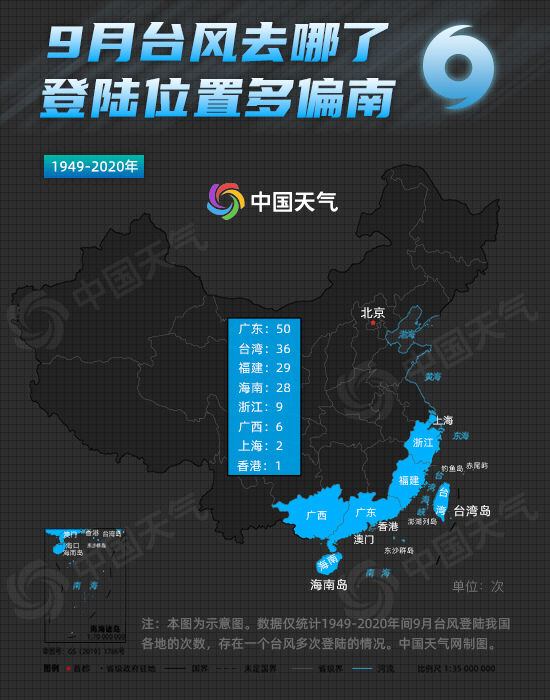
Taking September as an example, the typhoons that landed in China were concentrated in the south, and no typhoon landed in Jiangsu and its north. The most crowded places are Guangdong and Taiwan Province, followed by Fujian and Hainan, and the overall position is south.
Shi Yan, a meteorologist of China Weather Network, said that in autumn, the southward movement of typhoon landing point was related to the change of subtropical high position. Typhoons generally move along the periphery of the subtropical high. After entering September, the subtropical high gradually moves eastward and southward, and the typhoon is suppressed by the subtropical high, resulting in a southerly path. Therefore, autumn typhoons rarely affect Jiangsu, Shandong, Liaoning and other provinces with relatively northern geographical locations, and the influence scope is concentrated in South China.
Intensity: There are many typhoons in autumn, and the proportion of super typhoons is high.
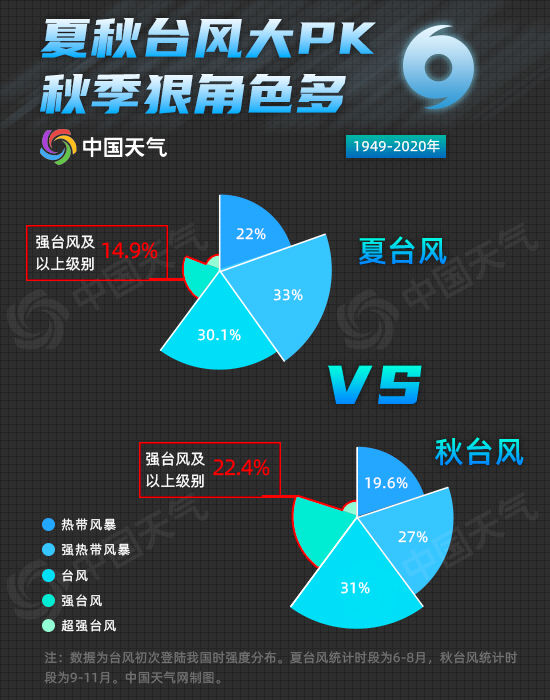
Although the number of typhoons generated and landed in summer is the largest in a year, meteorological big data shows that typhoons in autumn are more likely to play a "tough role". From 1949 to 2020, among the typhoons generated in autumn, super typhoons accounted for 27.9%, much higher than 18% in summer.
Judging from the intensity of typhoons landing in China for the first time, autumn typhoons are obviously higher than summer typhoons. In summer, typhoons mostly landed in China at the level of tropical storm or strong tropical storm, and only 14.9% reached the level of strong typhoon or above; In autumn, the proportion reached 22.4%, which was significantly higher than that in summer.
Impact: The impact of the autumn typhoon on the cold air disaster escalated.
Historically, there have been several autumn typhoons that have had a serious impact on China. According to the meteorological data from 1949 to 2020, there were seven super typhoons landing in China in September in the past 72 years. Although the probability is not high, once encountered, they are extremely destructive.
The strongest typhoon that landed in China in September was the 14th typhoon "Marge" in 1973. According to the data of the Central Meteorological Observatory, the typhoon "Marge" landed in Qionghai, Hainan in the early morning of September 14th, with the maximum wind speed of 60m/s near the center and the lowest pressure of 925 hectopascals. According to Xinhua News Agency, the typhoon caused 926 deaths, 1,690 serious injuries and 4,470 minor injuries in Hainan Province, and 126,000 houses collapsed, causing heavy losses.
In addition, the recent typhoon "Moranti", the 14th in 2016, is also very powerful. After it landed in Xiamen, it pushed all the way to the northwest, and the storm cloud system spread to 11 provinces and cities such as Fujian, Guangdong, Jiangxi, Zhejiang, Shanghai and Jiangsu, with strong winds and heavy rains in many places.

Why is autumn typhoon so destructive? Shi Yan, a meteorologist of China Weather Network, said that since the vernal equinox, the direct point of the sun has moved from the equator to the Tropic of Cancer, which has heated the tropical ocean in the northern hemisphere, and the heat of seawater has accumulated continuously. Usually, the sea temperature reaches the highest from August to September, and high sea temperature is conducive to typhoon generation and energy enhancement. At the same time, from the end of August to the beginning of September, cold air becomes active, which increases the pressure gradient and the wind speed near the typhoon center, which is also beneficial to the typhoon intensity. Therefore, in autumn, the probability of strong typhoon or super typhoon is higher.
Shi Yan reminded that the "ferocity" of the autumn typhoon not only reflects the intensity of the typhoon, but also the impact of the disaster may escalate. Due to the increasing cold air in autumn, typhoons are more likely to encounter cold air, and "autumn typhoon+cold air" is a terrible combination. The combination of the two will often trigger violent precipitation, which will lead to greater disasters.
For example, the 13th typhoon "Miyu" in 2010 was generated in October, and did not directly land in Taiwan Province. It drilled into the South China Sea from bashi channel, and then landed in Zhangpu, Fujian. A large amount of warm and humid air transported by typhoon circulation met with cold air from the north to the south, and the terrain uplift of the central mountain range of Taiwan Province caused the precipitation in Suao, Yilan, eastern Taiwan Province to exceed 1,000 mm, and the Suhua Highway collapsed, resulting in many deaths or disappearances.
Difficulty in forecasting: It is more difficult to forecast the changeable track of typhoon in autumn.
Autumn typhoons are not only outstanding in strength, but also often strange and changeable in path. According to "The Best Typhoon in China" compiled by the Central Meteorological Observatory in 2015, three typhoons were listed as "the most complicated typhoons", including No.16 typhoon Wayne in 1986, No.19 typhoon Nat in 1991 and No.16 typhoon Nari in 2001. Among them, "Nate" and "Lily" are both produced in autumn, and the life cycle of "Wayne" is also in late summer and early autumn.
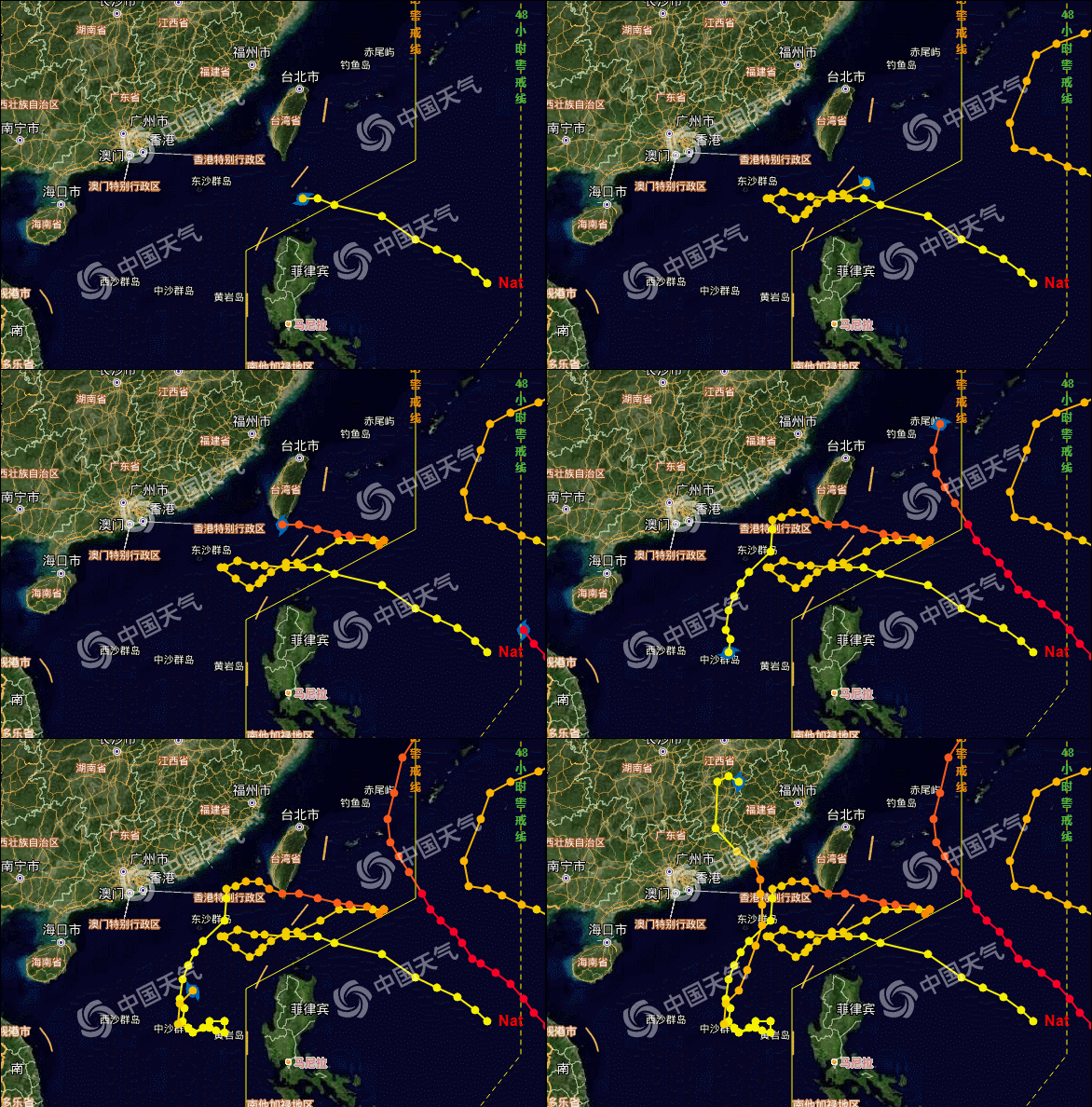
Route Map of Typhoon Nat No.19 in 1991
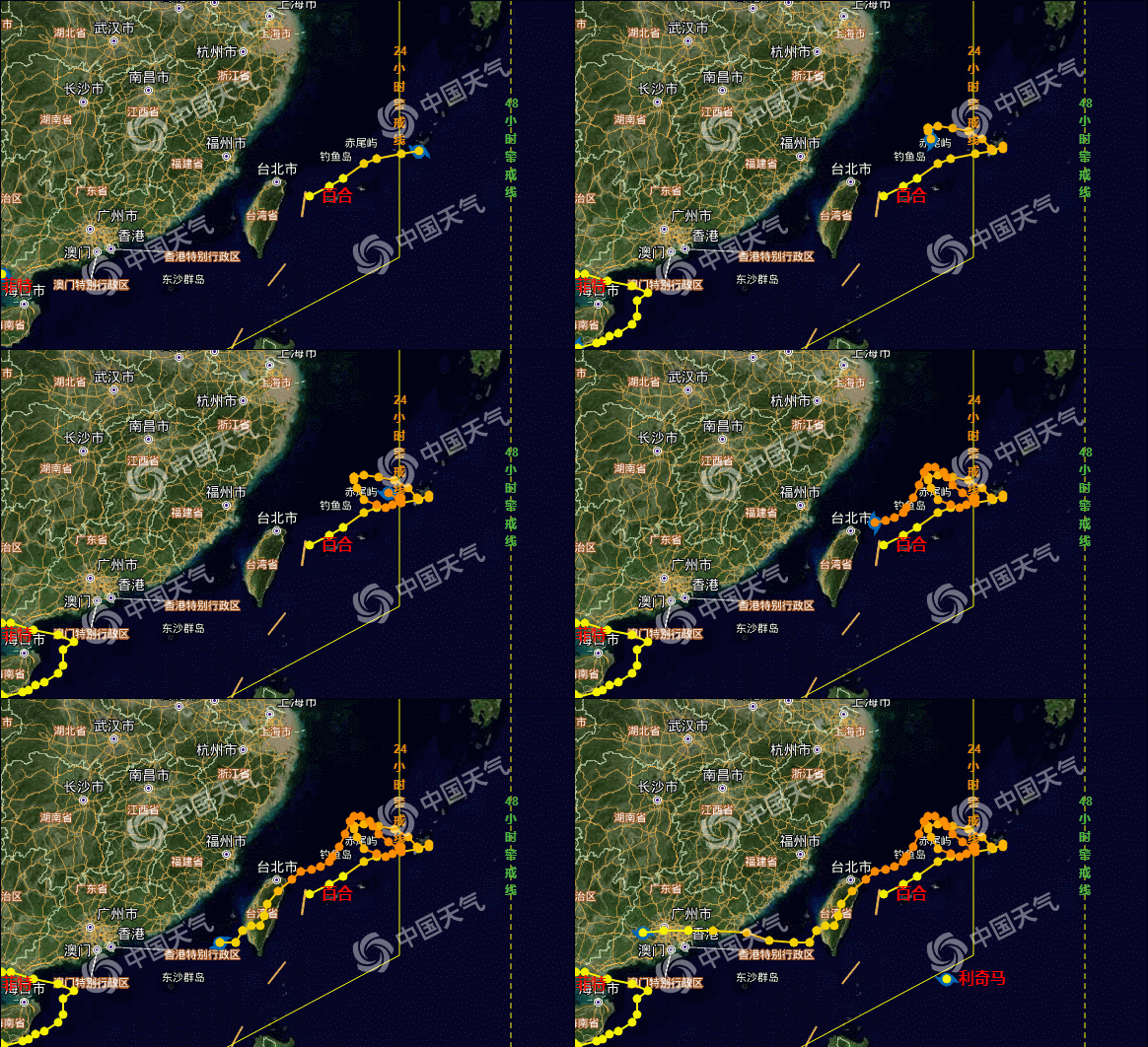
Route Map of Typhoon No.16 "Nari" in 2001
The path of autumn typhoon is more complicated and changeable, which is related to the weather system that affects autumn typhoon. Shao Peng, a meteorologist of China Weather Network, said that in autumn, such weather systems as westerlies, subtropical high and cold air play games with each other, regardless of the outcome, just like a "Xiong Haizi" is influenced and controlled by different "parents", so it becomes alternating between east and west, south and north, and the path is strange and changeable, which greatly improves the difficulty of prediction. Regardless of the difficulty or power of forecasting, autumn typhoons are full of "malicious roles" and their destructive power cannot be underestimated.
According to the forecast of the Central Meteorological Observatory, the 13th typhoon "Kang Sen" this year will approach the northern coast of Vietnam on the 13th through the offshore surface in the south of Hainan Island. The 14th typhoon "Candu" will move to the north after approaching the southern part of Taiwan Province Island, crossing the Taiwan Province Strait or passing the coast of Fujian and Zhejiang, entering the southern part of the East China Sea, and may also pass the eastern coast of Taiwan Province Island and move northward. Whether these two typhoons land or not, they will bring great storms to the southern coast of China, reminding the public in the relevant areas to pay attention to the approaching forecast and take preventive measures in advance. (Text/Zhang Hui Wang Wenwen Data Support/Shi Yan Shao Peng Design/Wei Lai Ren Chengying)