Trump pushed himself into a "dead end" after "extreme pressure"
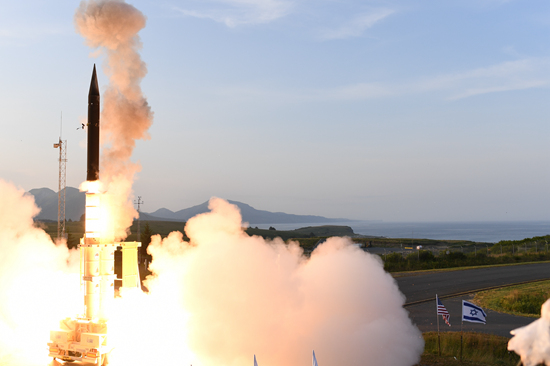
Israeli Prime Minister Benjamin Netanyahu said on July 28th local time that Israel and the United States successfully completed the live-fire interception test of the Arrow -3 anti-missile system in Alaska. Photo courtesy of vision china
On July 29, local time, US President Trump wrote on Twitter without warning: "Please remember that Iran has never won the war, but it has never lost in the negotiations." Although Trump didn’t explain what he meant, according to Wayne White, a former senior director of Middle East affairs at the the State Council Intelligence Research Bureau and now a policy expert at the Middle East Policy Research Committee, Trump probably didn’t expect to push himself into a "dead end" after one year when he announced his withdrawal from the Joint Comprehensive Action Plan (namely, JCPOA(Joint Comprehensive Plan of Action) for short) with a stroke of a pen a year ago.
Us-Iran negotiations or multilateral consultations
Although the United States is still threatening a "substantial" increase in sanctions against Iran recently, in fact, Trump is likely to have to face the embarrassment that the "extreme pressure" strategy has failed in Iran.
In May 2018, after Trump unilaterally announced that the United States had withdrawn from the Iranian nuclear deal, he had hoped to force Iran to return to the negotiating table through a series of "extreme pressure" measures such as economic, diplomatic and military measures, especially one-on-one direct negotiations with the United States on nuclear and ballistic missile programs. So far, however, Iran has rejected this proposal. The latest evidence is that US Secretary of State Pompeo’s request to visit Iraq was rejected.
On July 25th, Pompeo said that he was willing to go to Teheran to have a direct dialogue with the Iranian people and explain to them the reasons behind the US sanctions against Iran. Pompeo said that the goal of the United States is to try its best to stabilize the situation in the Middle East, so it will put pressure on Teheran to make changes. He said: "We want the Iranian leadership to make behavioral changes so that the Iranian people can get what they deserve."
However, Pompeo’s "kindness" was immediately rejected by Iranian officials on the grounds that "the United States does not want to negotiate at all, and they have no intention of dialogue". Iranian Foreign Ministry spokesman Mousavi said on the 29th that Iran recently offered to "strengthen international verification of Iran’s nuclear program in exchange for the lifting of sanctions by the United States", but this practical proposal was rejected by the United States, which shows that the United States simply does not want to engage in dialogue.
On July 18th, Iranian Foreign Minister Zarif said during his visit to the United States to attend the United Nations meeting that if the United States lifted the sanctions against Iran, Iran could immediately start to revise an additional protocol, so that the IAEA could check Iran’s nuclear program more deeply, instead of waiting until 2023 (according to the Joint Comprehensive Action Plan reached between Iran and the six countries on the Iranian nuclear issue in July 2015, Iran had to revise the additional protocol eight years after the agreement came into effect). However, the United States quickly rejected the Iranian proposal. Iranian Foreign Ministry spokesman Mousavi said on the 29th: "If the United States really wants to talk, we can ratify this additional protocol this year instead of waiting until 2023. But as we expected, the United States rejected this proposal because the United States did not want to engage in dialogue at all. "
In stark contrast to the deadlock in the US-Iran dialogue, the Iranian government is actively embracing multilateralism to counter the unilateral isolation policy of the United States. On July 28th, Iran and five the Iranian nuclear deal countries (Russia, China, Britain, France and Germany) held an emergency meeting in Vienna. Iranian Deputy Foreign Minister Aglac said that the atmosphere of the talks was "constructive". Although all problems have not been solved, all parties have made many commitments. Eshaq Jahangiri, Iran’s first vice president, also made it clear on July 29th that Iran’s foreign policy is to "resist American hegemonism and safeguard multilateralism". He said that if the Iranian nuclear deal’s other signatories fulfilled their obligations under the agreement, it would be reversible for Iran to reduce its commitment to the Iranian nuclear deal.
Although the Trump administration keeps putting pressure on the three European countries to join the sanctions camp against Iraq; Iran’s Atomic Energy Organization has also announced on 28th that it will rebuild the heavy water reactor in Arak in response to the "default" action of the United States, but the the Iranian nuclear deal five countries have still made it clear that they will continue to support the Iranian nuclear deal and hope to solve the current Iranian issue under the framework of the Iranian nuclear deal.
In this regard, Wayne White, a policy expert of the Middle East Policy Research Council of the United States, analyzed: "The escalating tension has left the Trump administration with few options. In addition to isolating itself, it is likely to push Trump to the military confrontation he is most unwilling to face."
Iran, the United States and Israel successively tested new weapons to increase the risk of confrontation.
Bolton, the national security adviser of the US President, confirmed on July 29th that the United States and Israel have successfully jointly tested the new anti-missile system, which undoubtedly aggravated the concerns of the outside world that the confrontation between the United States and Iraq will further move towards military confrontation.
Bolton wrote on Twitter on July 29: "The long-term cooperation between the United States and Israel in missile defense has made great progress. This successful test is not only a milestone in the national security of the two countries, but also contributes to the security of the Middle East. " He also attached a Jerusalem Post article to his tweet about the 10-day interceptor missile test conducted by the United States and Israel in Alaska.
On July 28th, Israeli Prime Minister and Defense Minister Benjamin Netanyahu announced that Israel and the US military had successfully conducted the interception test of the "Arrow -3" anti-missile system in Alaska, and the interceptor successfully intercepted a ballistic missile target outside the atmosphere, which verified the interception capability of the system outside the atmosphere. Netanyahu said that the success of the experiment "exceeded people’s imagination, and from the perspective of China’s security, this is a major achievement." Jon Hill, deputy director of the US Missile Defense Agency, also said: "This success in Alaska has made people full of confidence in Israel’s ability to deal with threats in the region’s development in the future."
The "Arrow -3" anti-missile system was jointly designed by the United States and Israel to deal with various potential threats, from Palestinian-armed homemade rockets to Iranian ballistic missiles, but the time when the United States and Israel tested this anti-missile system was interesting. Because just before Israel tested the new anti-missile system, Iran had just tested a medium-range ballistic missile with a range that could cover Israel. According to Pentagon officials on July 26th, Iran test-fired the Meteor 3 missile with a range of 1,000 kilometers on the evening of 24th, in order to improve the missile’s range and the accuracy of hitting targets, which is extremely threatening to the Middle East, Europe and even the United States. The Iranian military later confirmed the news, but insisted that Iran’s missile force is "absolutely defensive, in order to deal with potential aggression, not targeting any country, and does not need permission from any country."
In the eyes of many experts on international issues, Israel has played a vital role in the confrontation between the United States and Iran since last year, which is quite intended to add fuel to the flames and stir up military confrontation, while Iran’s tough stance on the United States and Israel has not changed, which has almost become the new normal of interaction between the United States, Iraq and Israel. Wayne White, a policy expert of the US Middle East Policy Research Council, said: "As the 2020 general election approaches, Trump will be more and more eager to fulfill his promise to the Jewish consortium in the 2016 general election: completely end the Iranian nuclear deal, so as to strive for this group. Continue to support him in next year’s general election."
In White’s view, Trump only cares about his own votes. "He doesn’t understand Iran. Those infamous advisers in his government, including Bolton, are still delusional about destroying the Iranian regime through extreme pressure." White analyzed, "Although ordinary people in Iran also complain about inflation and material shortage, the hostile challenges of the United States and Israel are often more likely to intensify their (religious) nationalism, and the cohesion of the foreign enemies is also increasingly enhanced."
"multilateral collective security concept" hedges against force "escort alliance"
In addition to diplomatic and military risks, Trump now has to face the possibility that his "Persian Gulf (force) escort alliance" will be replaced by the concept of multilateral collective security.
Vladimir Safronkov, Russian Deputy Permanent Representative to the United Nations, revealed on July 29th that Russia has submitted the Concept of Collective Security in Persian Gulf Region to the United Nations to prevent the rising risk of armed conflict in Persian Gulf waters.
In this concept, the Russian Foreign Ministry proposed that countries outside the Persian Gulf region should give up permanently stationing troops in the region, establish demilitarized zones, set up hotlines and exchange information on weapons procurement and armed forces, but proposed to establish a security organization composed of Russia, the United States, China, India, the European Union and other relevant countries.
Russia’s proposal of this security concept at this time is obviously to hedge the idea of "Persian Gulf escort alliance" thrown by the US earlier. In the past two months, the issue of safe passage in the Strait of Hormuz has become the most acute point of confrontation between the United States and Iran. The United States has proposed to form an "armed escort alliance" in the Persian Gulf, headed by the US military, with the Gulf countries as the main members and regional military allies as the supplement. Iranian military and political leaders have repeatedly threatened that Iran has the ability to blockade the Strait of Hormuz, but it is unwilling to do so because this sea route is of great significance to the country. How to resolve this risk, Russia seized the strategic opportunity and put forward the idea of multilateral collective security.
Of course, Russia is not without selfishness. In the report "Concept of Collective Security in the Persian Gulf Region", Russia explicitly demanded that "the troops of foreign countries leave the Persian Gulf region and respect the territorial sovereignty integrity of the Persian Gulf countries", which was obviously tailor-made for the United States. The United States has stationed a large number of military forces in the Middle East all the year round, and treated the countries in the Middle East differently. It is even more common to use the contradictions between different countries to provoke conflicts, pull sides and reap profits. Therefore, Russia’s concept of collective security at this time is quite intended to win over the countries in the Middle East, which coincides with Russia’s strategic intention to continue to seize the influence of the United States in the Middle East in recent years.