Villages polluted by "toxic water" containing cadmium
The farmland is polluted by waste mine sewage in Debao County, Guangxi. Official: A remediation plan is being prepared. The Beijing News is produced by our video.
The 60-year-old farmer stood barefoot in a deserted field, cutting weeds as feed for ducks. After two days of heavy rain, the land has become a swamp, full of weeds. The old farmer’s trousers are all black and red below the knee, and the big toe cover is also dyed red. He said that the washing powder can’t be washed off.
This is Daou Village, Daxi Village, Ma ‘ai Town, Debao County, Baise City, Guangxi Province. It is surrounded by mountains and cultivated land is scattered in mountain valleys. 300 meters to the east of Daoutun is an abandoned lead-zinc mine. Orange and black sewage flows out of the mine and floods the field with rain.
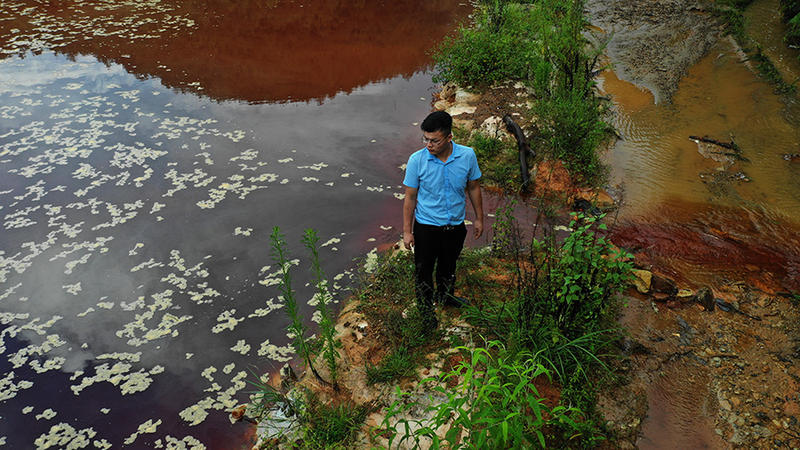
On September 8, orange-red and black-red sewage flowed out of the mine and flooded the fields with rain.
This piece of basic farmland with no rice and only weeds is about 40 mu. Going down the ravine, there is another 300 mu of farmland, which looks green and yellow. The villagers in Da ‘etun said that in the past, the rice yield per mu in this land was one thousand kilograms, but now it is only four or five hundred kilograms per mu on average, "it will die when it grows to a piece."
There are 140 households with more than 600 villagers in Da ‘etun, most of whom are farmers, and their livelihood depends on this 300-mu cultivated land. They told reporters that the "poisonous water" of polluted cultivated land comes from the abandoned lead-zinc mine.
The reporter learned that the treatment of abandoned lead-zinc mines has been put on the agenda, and the 20 million special treatment funds for soil remediation approved by the central government have also been put in place.
Poisonous water flows into irrigation canals.
The specific location of abandoned lead-zinc mine is in the mountain of Miaotun in Anyang village, so it is also called Neimiao lead-zinc mine. Most villagers in Neimiaotun and Daou Tun can’t tell clearly about its origin and development, except that the sewage from the mining area has flowed into farmland day and night for many years. Abandoned buildings and factories are usually children’s paradise, but the villagers think the wastewater is too toxic and warn the children not to get close.
On September 8, the reporter went to the waste mining area of Neimiao lead-zinc mine. The mining area is not large, and there are wastewater pits, tailings reservoirs, factory dormitories and mines from low to high according to the mountain situation. There are two mines. According to the Safety Operation Rules for Underground Workers dated August 1, 2004, the two mines are called Shuiluotianshun Mine Cave (Cantonese is the cave mouth) and Binbin Mine Cave mouth, and the work clothes of several years ago are still hung in the cave. Some buildings in the workshop and dormitory for mineral processing have collapsed; There are dozens of collapses of different sizes on the surface of tailings reservoir.
There are three drainage ditches in the production area of the mining area, one of which leads from two mine holes. The bottom of the sewage flowing in the mine hole is emerald green, the middle layer is transparent, and the upper layer is sauce red. After entering the drainage ditch, the turbid red and yellow water sticks to the foot of the mountain, which washes out the yellow marks on the rocks and finally flows into the irrigation canal in the farmland together with the sewage overflowing from the pit below. Another sewage ditch leads from the mineral processing workshop and specially discharges toxic sewage into the tailings pond; There is also an open ditch on the right side of the tailings pond to discharge the sewage overflowing from the reservoir and enter the two pits below. The water body is black and red and orange. Due to the serious rock dissolution around the tailings pond, large-scale multi-directional side leakage occurred in the reservoir, and emerald water oozed from the foot of the wall.
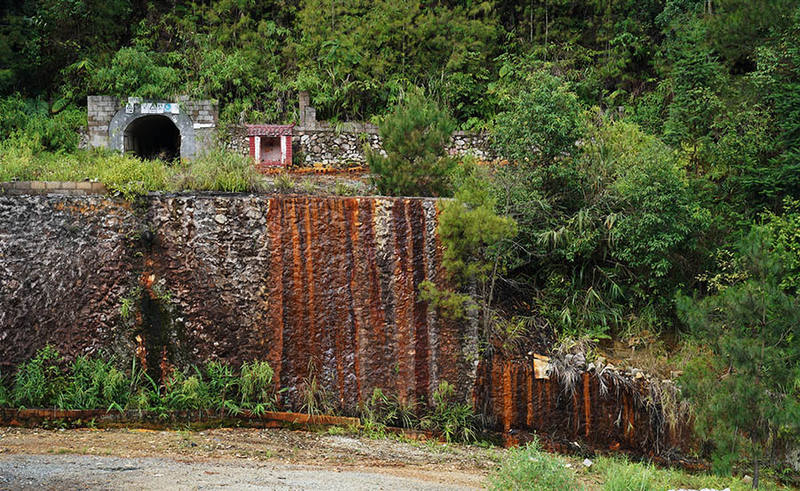
On September 9th, in Neimiao lead-zinc mine, after the strong acid water flowed out of the mine hole, part of it flowed down the wall made of cement and stone, and the wall was dyed rust.
Seen from the air, the whole abandoned mining area is like a colorful caterpillar crawling in the green forest. Using pH test paper and pH tester, the hydrogen ion concentration index of mine sewage, cliff near mine, three drainage ditch liquids, water seepage around tailings reservoir and two pit and pond wastewater were measured, and the pH values were all between 1 and 2, showing strong acidity.
At the distance of 100 meters, 200 meters and 300 meters from the waste lead-zinc mine, the water spilled from the irrigation canal into the farmland was tested, and the pH value was between 2 and 3.
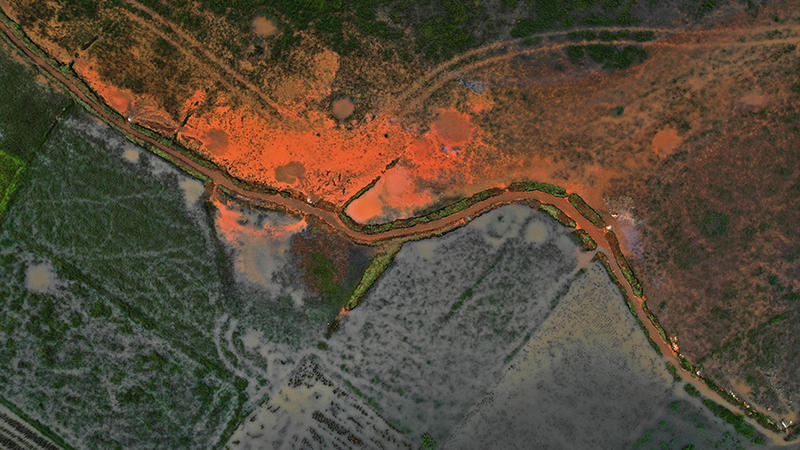 Viewed from the air,Orange pollution can be seen everywhere.
The sewage continues to flow along the irrigation canal to the field of more than 300 mu under the mountain. The sewage and rainwater flowing through the farmland are mixed with the sewage at the drainage gallery of Da ‘etun and collected into an underground river, and then flow from northwest to southeast into the flood interception ditch (Daxi River). The reporter learned from many villagers that the water will eventually flow into Jianhe River and into Debao County, more than ten kilometers away.
From the position of the demolished factory, you can see the farmland in the low-lying place in the distance, with a drop of about 50 meters. The toxic wastewater is discharged into the farmland all the year round without shelter along the drop, which continues to cause serious pollution of large areas of farmland and cannot be planted.
"ownerless" lead-zinc mine
Faced with the overflowing of strongly acidic sewage, environmental protection volunteers immediately reported to Debao County Ecological Environment Bureau and Debao County Government Office. The county government office and the monitoring brigade of the county environmental protection bureau each came to the scene, but they just looked at it and did nothing.
They said that the black-red pond was reinforced last year. When it doesn’t rain, it won’t be full. When it rains, it will overflow in large quantities. This situation has existed for a long time. Neimiao Pb-Zn mine is a "mine without owner", and the relevant regulation scheme is still being revised and improved.
Nong Leliang, secretary of the village committee of Daxi Village and director of the village committee, once worked in the Neimiao lead-zinc mine. Nong Leliang said that the Neimiao lead-zinc mine was built by a private boss, and started mining in 2005, put into production in 2007 and stopped production in 2008. There are two mines in lead-zinc mine, one is drilled 150 meters horizontally, the other is drilled 100 meters horizontally, and then drilled vertically. The waste rock blasted by mining is pulled to the top of the mountain by car and piled up in the open air. At first, the sewage came out of the mine and flowed directly along the open ditch to the lower mountain pond for storage. When the mountain pond was full, it overflowed, and there was no control measure.
According to the villagers in Daoutun, in recent years, they have repeatedly reported to the Central Environmental Protection Inspector about the environmental pollution caused by the Neimiao lead-zinc mine, and made letters and visits to the letters and calls bureaus at all levels. "There have been many media visits, and county leaders have also visited them."
Lu Lanbi, the county magistrate of Debao County, told the reporter that the Neimiao lead-zinc mine has exploration rights but no mining rights. The factory has environmental protection problems in the process of replacing exploration with mining, and was stopped after being reflected by the masses, but there has been no money to control it. In 2016, the county began to study how to control this problem.
According to the information provided by Debao County, the Neimiao lead-zinc mine in Debao County invested and built a factory in 2005, which belongs to an illegal mining enterprise that uses exploration instead of mining. Originally planned to mine for 20 years, but due to backward management, scientific and reasonable environmental protection measures were not taken in the production process of the mine, the management of waste residue generated in the production process was not in place, and waste gas and wastewater were discharged at will, which caused the farmland and surface water around the site to be polluted to varying degrees and was shut down in 2008 according to law.
The Baise Municipal People’s Government Network shows that on June 18, 2018, Yi Handong, chief engineer of the Municipal Bureau of Ecology and Environment, led a team to conduct supervision work at the Neimiao lead-zinc mine tailings pond in Debao County.
Yi Handong told reporters that when he went to the site, he found that things were serious and the pollution was serious. In addition, the buildings in the factory had been bombed, and the equipment did not exist. I couldn’t see the specific mining and dressing process, but there was definitely no smelting part (referring to the methods of roasting, smelting, electrolysis and using chemicals to extract the metals from the ore), which may be gravity separation (gravity separation).
Yi Handong said that there are two sources of pollution, one is the wastewater from the mine and the other is the wastewater from the slag leached by rain. Groundwater from the vicinity of lead-zinc sulfide mine is rich in sulfate, which is sulfuric acid water. The industrial behavior of mining has released heavy metals such as cadmium and arsenic, which originally existed in the form of compounds. The monitoring of water samples and soil shows that lead, zinc, cadmium and arsenic all exceed the standard by one time or several times.
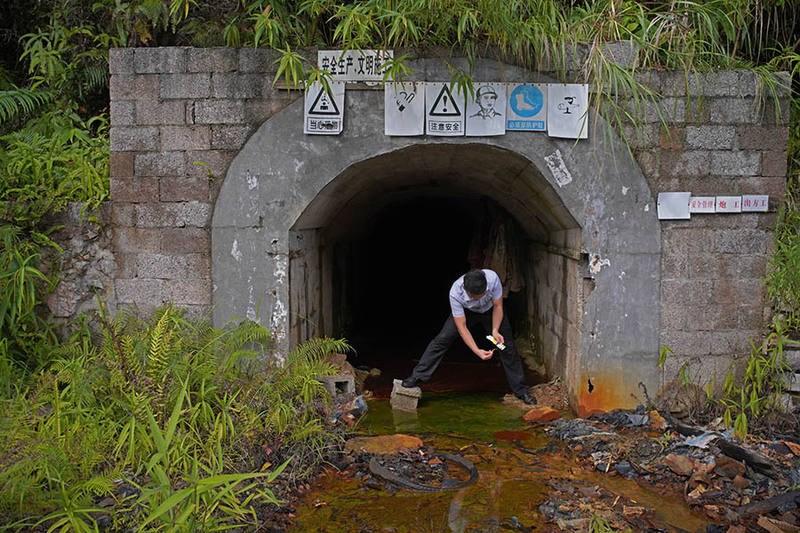
On September 8, environmental volunteers used PH test paper at the entrance of the mine, and the PH value of the effluent was between 1 and 2, which was strong acid water.
Yi Handong, chief engineer of Baise Ecological Environment Bureau, said that the wastewater also contains heavy metals. Yi Handong said that the pollution situation of Neimiao lead-zinc mine is complicated, sewage flows all the year round, water pollution is the source, and soil pollution is the consequence, so it is very difficult to comprehensively control and the repair cost is too high. Now that the owner can’t find it, the county government needs to bear this responsibility. The county government should find a professional institution to investigate, diagnose and prescribe prescriptions as soon as possible. At the same time, declare the central special fund for soil pollution prevention and control or the provincial soil pollution prevention and control fund.
Soil and crop testing data have not been published.
After the advice of Baise Environmental Protection Supervision Team, all departments of Debao county government strengthened the site facilities of Neimiao lead-zinc mine in safety.
Last year, a tailings pond was added to the waste lead-zinc mine to fix the slag and prevent it from losing. Li Zhiming, deputy director of the Emergency Management Bureau of Debao County, said that it has been completed, but the investment capacity is insufficient. The bid price is 2.45 million yuan, so we can only make as much money as we can, and we have not yet accepted the settlement.
Last year, the Water Conservancy Bureau of Debao County also made anti-seepage treatment for the edge of the sewage collection pond. Considering the limited water storage capacity of the pond, when it rains, it is very dangerous to collect a large amount of water. Deputy Director Lu of the County Water Conservancy Bureau said that the pond was specially left with a gap of 1 meter wide to let the water drain down, in order to prevent the pond from being washed away by water at once, which would cause greater damage.
Strengthening tailings ponds and mountain ponds has reduced safety risks, but the source of cadmium pollution has not been blocked. Waste mineral water containing heavy metals such as cadmium is still flowing to cultivated land day and night.
In the specialty of physical chemistry, heavy metal migration refers to the movement of spatial position and the transformation of existing forms of heavy metals in the natural environment, as well as the enrichment and dispersion caused by it. Cadmium, a heavy metal, is special, difficult and highly migratory. It can easily enter water and soil, be enriched by plants, and then enter the human body through the food chain, resulting in chronic poisoning.
Relevant experts said that firstly, cadmium was released by mining, which polluted the water, and then the polluted water entered the farmland, which polluted the soil. Rice was the cereal crop with the strongest absorption of cadmium. The contaminated rice farmers used it for their own use or sold it, and eventually long-term consumption would damage human renal function, hinder bone growth and metabolism, and cause various bone diseases, such as "painful disease".
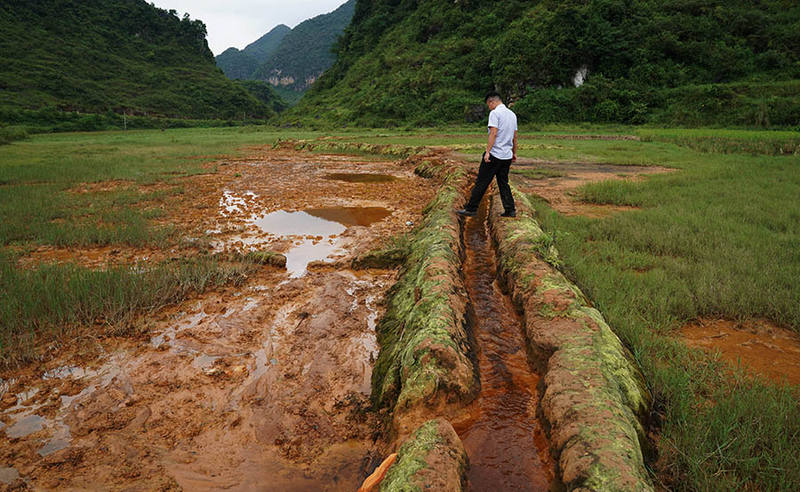
On September 8, volunteers tested the water that overflowed from the irrigation canal into the farmland, and the pH value was between 2 and 3.
The field that Xu Qi, a villager, abandoned was in the cultivated land where the rice was never harvested. "The water is red, people step on the ground, the mud is knee-high, the mud is like tofu residue, and the cows refuse to leave, so they can’t plant it at all. But if you don’t plant it, where can you get rations? " He can only turn the mountain bay, where the sewage can’t flow, and plant the land for migrant workers.
In a 300-acre field, a 50-year-old villager surnamed Nong said that he had seen a film polluted by lead-zinc mine on TV, "People with cadmium poisoning finally showed their bones." Ten years ago, he began to worry about bone lesions. He has learned some knowledge and knows that even if he stops contact, cadmium may accumulate in the human body along the original path.
"In the past two or three years, the county agricultural and rural bureaus will come to the fields to make measurements, and the rice has also been tested, but the inspection results will not tell us." Nong Leying, a villager from Daou Tun, said.
Tang Bosheng, director of the Agriculture and Rural Affairs Bureau of Debao County, said that the Agriculture and Rural Affairs Department of the autonomous region will test the soil and agricultural products in different sections every year, and the county bureau is only responsible for sampling and handing in, and the soil and crops within 5 kilometers of the tailings of Neimiao lead-zinc mine have been tested. "The test data will not tell us, and it is useless for us to take it, and we can’t control it."
The reporter proposed to check the test data of excessive heavy metals in water, soil and crop roots within 5 kilometers of Neimiao lead-zinc mine. The leaders of Debao County said that these tests were confidential and the information could not be made public because of social stability considerations.
20 million soil remediation funds
Once the soil is polluted, it is unimaginable that it is difficult and costly to remove the pollutants. Especially in poor places, there are big problems in controlling soil pollution, lack of funds and technology.
On January 1, 2019, China officially implemented the Law on the Prevention and Control of Land Pollution, which gave clear answers to the core problems such as insufficient funds for soil pollution control, unaffordable large-scale restoration, identification of the person responsible for pollution control, who will pay for pollution control, the use of special funds for soil pollution control, and how to severely punish pollution behavior. Experts believe that legislation is to solve the problem that no one is responsible for soil pollution and solve the problem of contaminated land left over from history.
Wang Canfa, a member of the State Environmental Protection Expert Committee of the Ministry of Ecology and Environment and a professor at China University of Political Science and Law, told the reporter that the amount of central subsidy funds during the special implementation period of the central soil pollution prevention and control reached 50 billion yuan, and it will be 5 billion yuan in 2019. All 31 provinces, municipalities and autonomous regions in China have allocated funds, which is very strong.
The reporter learned from Director Xu of the Ecological Environment Bureau of Debao County that since 2018, the county has entrusted a third-party organization to conduct site investigation and preparation of remediation plans for Neimiao lead-zinc mine, and the soil pollution status and pollutant distribution have been identified. At present, the preliminary examination plan has been passed, and the 20 million special funds for soil remediation just approved by the central government have also been put in place.
On the idea of comprehensive treatment, Yi Handong, chief engineer of Baise Eco-environmental Protection Bureau, said that a small sewage treatment plant would be built near the mine, and heavy metal ion precipitants would react with various heavy metal ions to generate flocculent sediments insoluble in water, thus separating heavy metals from wastewater. Shantang emergency pool should optimize seepage prevention and cut off the leaching of external rain, and the flood intercepting ditch of tailings pond should be fixed in the area, and the water should be introduced into the sewage treatment plant with sewage pipes.
Yi Handong estimated that the 20 million special treatment fund for soil remediation is only the first phase, and the whole treatment will cost 50-60 million yuan. In addition, the sewage treatment plant should also consider the next economic benefits.
In its reply, the Department of Ecology and Environment of Guangxi Zhuang Autonomous Region stated that because Guangxi belongs to an economically underdeveloped area, the historical burden of soil pollution in the past was heavy, but in recent years, "the overall situation of soil environment in the whole region is stable, there is no sudden environmental accident of soil pollution, and there is no incident that the quality of agricultural products exceeds the standard due to soil pollution of cultivated land and causes adverse social impact".
The Department of Ecology and Environment of the Autonomous Region said, "For the projects that have received financial support, they should be refined and improved according to the review opinions and the amount of funds fed back by the Ministry of Ecology and Environment. After the revision and improvement, the bidding work can be carried out after the approval of our office. In principle, the projects supported by central funds should be completed within 2 years after the start of construction."
The reporter was informed that the Debao county government is currently organizing the refinement and optimization of the project implementation plan, which has not yet been submitted to the ecological environment department of the autonomous region for review.
Writing/Beijing News Chief Reporter Liu Min Photography/Beijing News Chief Reporter Chen Jie Editor hujie Proofread Yang Xuli
Comment: The village is polluted by "toxic water" containing cadmium, and the test data cannot be classified information.